Enterprise web solutions are secure, scalable web applications designed to support business-critical operations across an organisation. Unlike traditional business websites that primarily provide information, enterprise web solutions integrate with systems such as ERP, CRM, HR, finance, and supply chain platforms to automate processes, improve collaboration, and deliver seamless digital experiences for employees, customers, and partners.
As organisations grow, they need platforms capable of handling increasing workloads, complex integrations, strict security requirements, and evolving business processes. Whether you’re building a customer portal, B2B commerce platform, enterprise SaaS application, or internal workflow system, the decisions made during planning and development directly impact long-term scalability, security, and operational efficiency.
Modern businesses rely on connected digital ecosystems rather than isolated applications. Enterprise web solutions centralise business operations, improve collaboration across departments, and integrate data from multiple systems to support faster, more informed decision-making.
A well-designed enterprise platform can help organisations:
- Automate complex business workflows
- Integrate ERP, CRM, HRMS, payment gateways, and third-party applications
- Improve customer and employee experiences
- Scale efficiently as the organisation grows
- Strengthen security, compliance, and governance
- Enable AI-powered automation and business intelligence
Rather than solving a single problem, enterprise web solutions create a foundation that supports digital transformation and future innovation.
Start With Business Requirements, Not Technology
One of the biggest mistakes organisations make is selecting technologies before understanding the business problem they need to solve.
Before choosing an architecture, cloud platform, or AI framework, define the business objectives first.
Ask questions such as:
- Which business processes will this platform automate?
- Which departments, customers, or partners will use it?
- Which existing systems require integration?
- How many users will the platform support today and in the future?
- What security or compliance standards must be met?
A customer self-service portal with 500 users has very different requirements from a global enterprise platform supporting thousands of concurrent users across multiple regions. Starting with clear business requirements helps reduce technical debt and ensures the solution remains scalable as the organisation grows.
Choosing the Right Architecture
There is no single architecture that fits every enterprise application. The right choice depends on your business goals, development team, operational maturity, and expected growth.
Modular Monolith vs. Microservices
For most organisations building a new enterprise platform, a Modular Monolith provides the best balance between scalability, maintainability, and development speed. It keeps the application organised into well-defined business modules while avoiding the operational complexity of managing multiple independent services.
Microservices become valuable when organisations have multiple engineering teams, frequent independent deployments, and specific services that need to scale independently.
| Modular Monolith | Microservices |
| Best for startups, SMBs, and growing enterprises | Best for large organisations with multiple development teams |
| Simpler deployment and maintenance | Independent deployment for each service |
| Lower infrastructure and operational costs | Greater operational complexity but higher flexibility |
| Easier debugging and monitoring | Better independent scalability |
A simple rule is to start with a Modular Monolith unless you have clear operational reasons to adopt Microservices. It’s far easier to extract services later than to simplify an overly distributed architecture.
For applications requiring real-time processing, such as logistics, banking, or retail inventory systems, event-driven communication using technologies like Kafka or RabbitMQ can be introduced as the platform evolves.
Enterprise Technology Stack
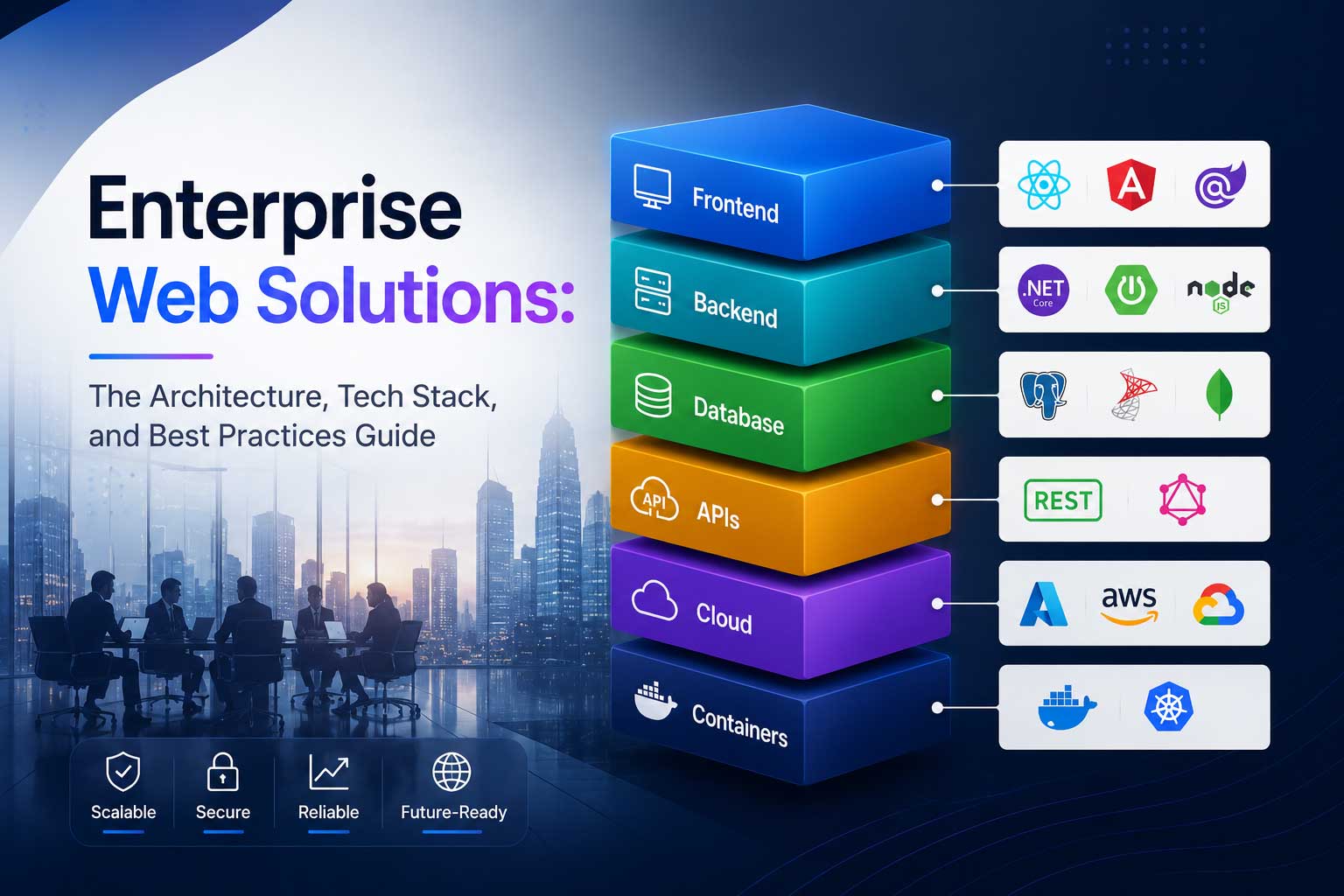
Choosing the right technology stack is just as important as selecting the right architecture. Modern enterprise applications typically combine proven technologies that prioritise scalability, performance, security, and long-term maintainability.
| Layer | Common Technologies |
| Frontend | React, Angular, Blazor |
| Backend | ASP.NET Core, Java Spring Boot, Node.js |
| Database | PostgreSQL, SQL Server, MongoDB |
| APIs | REST, GraphQL |
| Cloud | Microsoft Azure, AWS, Google Cloud |
| Containers | Docker, Kubernetes |
Rather than following technology trends, businesses should choose technologies that align with their internal expertise, integration requirements, and long-term business objectives.
API-First Integration, Security & Scalability
Enterprise applications rarely operate in isolation. They need to exchange data with ERP systems, CRM platforms, payment gateways, identity providers, analytics tools, and third-party services. An API-first approach ensures these integrations remain consistent, scalable, and easier to maintain as business requirements evolve.
Designing APIs around business functions rather than database tables allows development teams to build web, mobile, and partner applications independently without creating unnecessary dependencies. This flexibility becomes increasingly important as organisations expand their digital ecosystem.
Security and scalability should also be built into the platform from the beginning rather than added later. Enterprise applications often manage sensitive customer information, financial records, and operational data, making security a critical business requirement.
Key considerations include:
- Zero Trust security with continuous identity verification
- Multi-factor authentication (MFA) and Role-Based Access Control (RBAC)
- End-to-end encryption for data in transit and at rest
- Secure API gateways and centralised audit logging
- Compliance with standards such as GDPR, HIPAA, PCI DSS, or SOC 2
- Load balancing, distributed caching, and horizontal scaling to support growing workloads
Building these capabilities into the architecture early helps organisations reduce risk, improve performance, and support future business growth without major redevelopment.
AI-Driven Enterprise Web Solutions
Artificial Intelligence is becoming a core capability of modern enterprise applications rather than an optional feature. Businesses are increasingly using AI to automate document processing, improve customer support, analyse business data, detect fraud, and optimise operational workflows.
One of the most valuable approaches is Retrieval-Augmented Generation (RAG). Unlike generic AI models that rely only on public knowledge, RAG retrieves information from your organisation’s own documents, databases, and knowledge repositories before generating a response. This significantly improves accuracy, reduces hallucinations, and helps keep sensitive business information within your security environment.
By designing enterprise platforms with AI readiness in mind, including structured data, API-based integrations, and scalable infrastructure, organisations can introduce intelligent automation without rebuilding their systems in the future.
Best Practices for Enterprise Web Development
Successful enterprise platforms are built around long-term business objectives rather than short-term technology trends. Following proven development practices helps organisations reduce technical debt and improve system reliability.
Best practices include:
- Start with clearly defined business requirements before selecting technologies.
- Choose an architecture that matches your team’s size and operational maturity.
- Design API-first to simplify integrations with internal and external systems.
- Build security, compliance, and scalability into the platform from day one.
- Automate testing, deployment, and monitoring to improve software quality.
- Design systems using modular components that can evolve as business needs change.
Common Mistakes to Avoid
Many enterprise projects become unnecessarily expensive because of avoidable planning mistakes. Some of the most common include:
- Choosing Microservices before the organisation is ready.
- Prioritising technology trends over business requirements.
- Delaying integration planning until late in development.
- Treating security as a compliance exercise instead of an architectural principle.
- Building systems that cannot easily support future AI capabilities.
Avoiding these mistakes results in more maintainable platforms, lower operational costs, and faster delivery of new business capabilities.
Enterprise web solutions enable organisations to automate business operations, integrate critical systems, improve security, and scale digital services as they grow. While every organisation has unique requirements, successful platforms share common characteristics: they are designed around business goals, built with scalable architectures, secured from the start, and prepared for future technologies such as AI and intelligent automation.
Choosing the right architecture, technology stack, and integration strategy early in the project reduces technical debt and creates a strong foundation for long-term digital transformation.
FAQs
What are enterprise web solutions?
Enterprise web solutions are secure, scalable web applications that support core business operations, integrate with enterprise systems such as ERP and CRM platforms, and help organisations automate workflows, manage data, and improve operational efficiency.
How are enterprise web solutions different from traditional websites?
Traditional websites primarily provide information or marketing content, while enterprise web solutions support business-critical functions such as customer portals, workflow automation, inventory management, employee collaboration, and enterprise software integrations.
Which architecture is best for enterprise web applications?
For most new enterprise platforms, a Modular Monolith offers faster development and lower operational complexity. Microservices become beneficial when multiple independent teams need to deploy and scale different services separately.
Which technologies are commonly used for enterprise web development?
Enterprise web solutions are commonly built using technologies such as React, Angular, Blazor, ASP.NET Core, Java Spring Boot, Node.js, PostgreSQL, SQL Server, Docker, Kubernetes, and cloud platforms including Microsoft Azure, AWS, and Google Cloud.
Can enterprise web applications integrate with ERP and CRM systems?
Yes. Modern enterprise applications are designed using API-first principles, making it easier to integrate with ERP, CRM, payment gateways, identity providers, and other third-party business systems.
Why should businesses prepare enterprise applications for AI?
Designing platforms with AI readiness allows organisations to introduce intelligent automation, enterprise search, document intelligence, and Retrieval-Augmented Generation (RAG) without rebuilding their existing systems, helping maximise long-term technology investments.
Build Enterprise Web Solutions That Scale With Your Business
Whether you’re developing a customer portal, modernising legacy software, building a B2B commerce platform, or creating a custom enterprise application, success depends on choosing the right architecture, technology stack, and development strategy from the beginning.
At Zobi Web Solutions, we help businesses design, develop, and modernise enterprise web solutions that are secure, scalable, and built for long-term growth. From architecture consulting and API-first development to cloud-native deployment and AI-powered enterprise applications, our team delivers solutions that align technology with business outcomes.