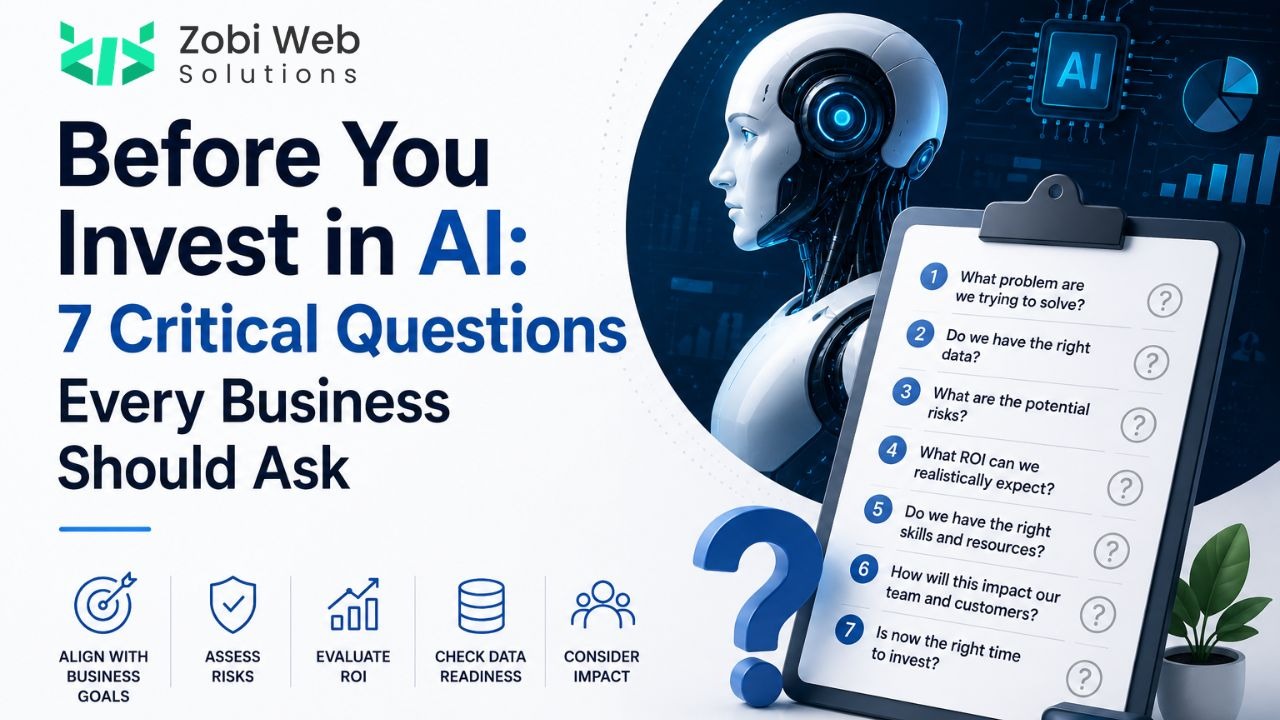
The questions every business should answer before choosing an AI consulting company, investing in AI solutions, or approving an implementation budget.
Artificial intelligence has moved from innovation labs to boardroom discussions.
Across the United States, organisations are investing in generative AI solutions, intelligent automation, AI agents, and advanced analytics to improve efficiency, reduce costs, and unlock new growth opportunities. Yet despite growing investment, many AI initiatives struggle to deliver the business outcomes leaders expect.
The reason isn’t that AI technology falls short.
The real challenge is that many businesses invest in AI before fully understanding the problem they’re trying to solve, their organisation’s readiness, or the expected return on investment.
Successful AI adoption isn’t about implementing the latest technology. It’s about identifying the
right opportunities, selecting the right approach, and ensuring every investment aligns with measurable business goals.
Before hiring an AI consulting company, engaging an AI development company, or approving a significant AI budget, business leaders should answer a few critical questions. The answers often determine whether AI becomes a competitive advantage or an expensive lesson.
The Biggest AI Mistake Isn’t Moving Too Slowly
Many executives worry about falling behind competitors in the race to adopt AI.
While that concern is understandable, the bigger risk is often moving too quickly.
Organisations frequently invest in AI because competitors are doing it, stakeholders are demanding innovation, or vendors are promising transformational results. Without a clear strategy, however, AI initiatives can quickly become fragmented projects that consume time, budget, and resources without producing meaningful business value.
The companies seeing the strongest results from AI are not necessarily the first to adopt it. They are the ones that invest with purpose.
They first understand the problem, validate the opportunity, assess implementation requirements, and define success before selecting a solution.
Whether you’re a manufacturing company exploring predictive maintenance, a healthcare provider looking to reduce administrative workloads, or a logistics business aiming to improve forecasting accuracy, successful AI adoption starts with strategy, not technology.
Why Businesses Lose Money on AI Projects
Most failed AI initiatives don’t fail during development.
They fail during planning.
Businesses often underestimate the importance of readiness, integration, and long-term execution. As a result, they invest in technology before validating whether the solution aligns with their business objectives.
Common reasons AI projects underperform include:
- Unclear business goals
- Poor data quality and accessibility
- Choosing technology before validating use cases
- Lack of integration planning
- Unrealistic ROI expectations
- Limited adoption strategies
- No post-deployment optimisation plan
For example, a logistics company may implement AI forecasting tools without addressing inconsistent operational data. A financial services organisation may automate document processing without properly evaluating compliance and workflow requirements.
In both cases, the issue isn’t the AI itself.
The issue is the strategy behind it.
This is why many organisations begin with AI consulting services before moving into development. Strategic planning often prevents costly mistakes later in the implementation process.
What Business Problem Are You Trying to Solve?
The first question should never be
“Which AI platform should we use?”
Instead, ask:
“What business challenge are we trying to solve?”
AI should support business objectives, not become the objective itself.
A manufacturing company experiencing equipment downtime will have different AI requirements than an eCommerce business focused on customer engagement or a healthcare provider seeking operational efficiency.
Before evaluating technology, identify:
- Which processes are slowing growth?
- Where are teams spending excessive time on repetitive tasks?
- What operational bottlenecks affect performance?
- Which customer experiences need improvement?
- Where can better insights improve decision-making?
Organisations that clearly define business challenges before selecting AI solutions are far more likely to achieve measurable outcomes.
Is Your Business Ready to Generate ROI From AI?
Many organisations believe they are AI-ready because they have years of customer and operational data.
Unfortunately, data volume doesn’t guarantee data readiness.
AI systems rely on accurate, accessible, and structured information. If data is fragmented across multiple systems, duplicated, outdated, or inconsistent, implementation becomes significantly more challenging.
Before investing, evaluate:
- Is your data reliable and trustworthy?
- Are systems integrated?
- Can information be accessed efficiently?
- Are workflows documented and standardised?
- Is leadership aligned on expected outcomes?
An experienced AI development company will assess readiness before recommending implementation strategies, because strong AI outcomes begin with a strong operational foundation.
Organisations that prioritise readiness often achieve faster deployments, stronger adoption, and better long-term ROI.
How Will You Measure Success?
One of the biggest reasons AI projects fail to demonstrate value is the absence of clearly defined success metrics.
Without measurable objectives, it’s difficult to determine whether the investment was successful.
The most effective AI initiatives are tied directly to business outcomes.
For example:
- A healthcare organisation may focus on reducing administrative workloads and improving operational efficiency.
- A logistics company may measure forecasting accuracy and cost savings.
- A financial services firm may prioritise processing speed and risk reduction.
- An eCommerce company may focus on conversion rates and customer retention.
Common AI KPIs include:
- Revenue growth
- Reduced operational costs
- Improved profit margins
- Increased employee productivity
- Faster response times
- Better forecasting accuracy
- Improved customer satisfaction
AI should always be evaluated based on business impact—not technical complexity.
Do You Need Automation, Generative AI, or AI Agents?
Not every business needs the same type of AI solution.
One of the most common mistakes organisations make is investing in technology that doesn’t align with their objectives.
AI Automation
Best for streamlining repetitive workflows, reducing manual effort, and improving operational efficiency.
Generative AI Solutions
Ideal for content generation, knowledge management, customer support, document summarisation, and enterprise search.
AI Agents
Designed to perform multi-step tasks, interact with systems, make decisions, and execute workflows with minimal human involvement.
The right solution depends on your business goals, operational requirements, and expected outcomes.
An experienced AI agent development company can help identify which approach will deliver the greatest value to your organisation.
Will This AI Investment Still Deliver Value in Three Years?
Many AI initiatives perform well during pilot programs but struggle when scaled across departments or business units.
Before moving forward, ask:
- Can the solution support future growth?
- Will it integrate with evolving technology stacks?
- Can additional use cases be added over time?
- Will it adapt to changing business requirements?
Scalability should be part of every AI strategy from the beginning. Organisations that treat AI as a long-term business capability rather than a short-term project often generate stronger returns and greater competitive advantages.
How Will AI Integrate With Existing Systems?
Even the most sophisticated AI solution will struggle to create value if it operates in isolation.
Most businesses rely on multiple systems, including:
- CRM platforms
- ERP software
- Customer service tools
- Internal databases
- Business intelligence platforms
For AI to deliver meaningful results, it must connect seamlessly with existing workflows and infrastructure. Strong AI integration services help ensure smooth adoption, reliable data flow, and long-term scalability. Integration planning should never be treated as an afterthought.
What Happens After Deployment?
One of the biggest misconceptions about AI is that deployment marks the end of the project.
In reality, deployment is where long-term value creation begins.
AI systems require:
- Ongoing monitoring
- Performance optimization
- Governance and compliance oversight
- Model improvements
- Continuous maintenance
Business requirements evolve. Customer expectations change. New opportunities emerge.
Organisations that continuously optimise their AI investments consistently achieve stronger outcomes than those that treat implementation as a one-time initiative.
Red Flags When Evaluating an AI Vendor
Choosing the wrong AI partner can significantly impact project success.
Be cautious if a provider:
- Recommends technology before understanding your business objectives
- Promises unrealistic ROI or implementation timelines
- Focuses solely on development without discussing strategy
- Avoids conversations about data readiness
- Lacks integration expertise
- Offers little support after deployment
- Cannot clearly explain how success will be measured
A qualified AI consulting company should focus on business outcomes, implementation feasibility, scalability, and long-term value creation, not just technology features.
The best partners ask challenging questions before proposing solutions.
Need Help Evaluating Your AI Strategy?
Investing in AI without a clear roadmap can lead to unnecessary costs, delayed adoption, and disappointing results.
At Zobi Web Solutions, we help organisations identify high-impact AI opportunities, assess technical readiness, validate ROI potential, and build implementation strategies aligned with measurable business outcomes. Whether you’re exploring Generative AI solutions, AI agents, AI integration services, business process automation, or custom AI development, our team delivers practical, scalable solutions tailored to your goals.
Because the most expensive AI mistake isn’t choosing the wrong platform; it’s investing before you fully understand the outcome you’re trying to create.
Blazor
Angular
ASP.NET Core
NodeJS
React Native


60+