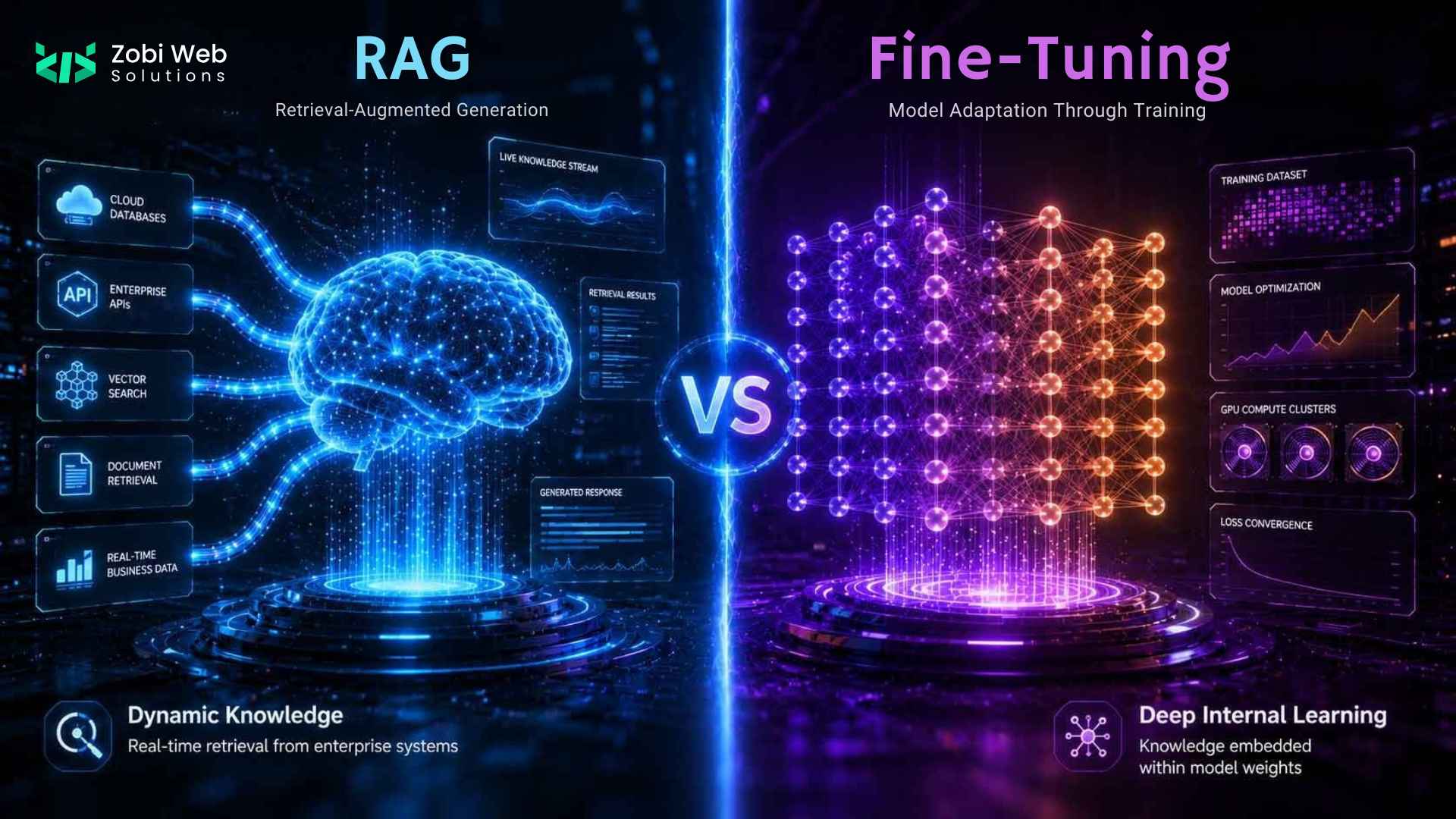
Enterprises across the USA are rapidly adopting generative AI to automate workflows, improve decision-making, and build intelligent customer experiences. As businesses scale their AI initiatives, one critical question continues to emerge: Should organisations use Retrieval-Augmented Generation (RAG) or fine-tuning for enterprise AI systems? Both approaches enhance Gen AI models differently, impacting scalability, accuracy, infrastructure cost, and long-term business performance.
Understanding When Enterprises Should Use RAG or Fine-Tuned AI Models
Enterprise AI adoption in the USA is evolving rapidly as organizations move beyond basic chatbot deployments toward scalable AI ecosystems that improve operational efficiency, automate workflows, and strengthen decision-making. Businesses across healthcare, finance, SaaS, logistics, legal services, and retail are investing heavily in AI development to modernize internal operations and customer experiences.
One of the most important architectural decisions in enterprise AI implementation is choosing between Retrieval-Augmented Generation (RAG) and fine-tuning. Recognizing how these approaches address different enterprise challenges helps you make informed decisions aligned with your long-term goals.
At Zobi Web Solutions, we help organisations evaluate, design, and deploy enterprise AI systems that align with scalability and compliance goals.
A Practical Comparison of RAG and Fine-Tuning for Enterprise AI Systems
Retrieval-Augmented Generation (RAG) combines large language models with external enterprise knowledge sources such as databases, cloud storage, APIs, CRMs, PDFs, documentation systems, and internal business platforms. Instead of relying only on model training data, the system retrieves relevant information in real time before generating responses.
Fine-tuning works differently. It adapts Gen AI models using enterprise-specific datasets so the models learn specialised language patterns, workflows, terminology, and response behavior.
This distinction is critical for enterprise AI development because businesses often require:
- Real-time knowledge access
- Industry-specific intelligence
- AI automation solutions
- Enterprise-grade security
- Scalable AI infrastructure
- Accurate business responses
Modern enterprises increasingly evaluate both approaches as part of broader AI integration services and LLM application development strategies.
How Businesses Choose Between RAG and Fine-Tuned Large Language Models
Large organisations typically analyse enterprise AI architecture based on:
- Scalability
- Deployment speed
- AI governance
- Infrastructure cost
- Security compliance
- Knowledge management efficiency
- Long-term maintenance requirements
When Enterprises Prefer RAG Development Services
RAG development services are highly effective for businesses that need access to constantly evolving enterprise information.
Common enterprise use cases include:
- AI-powered enterprise search
- Internal knowledge assistants
- Customer support automation
- AI document intelligence systems
- Enterprise chatbot development
- Workflow automation platforms
- Multi-source business data retrieval
For example, a healthcare provider may deploy a RAG-powered AI assistant that instantly retrieves up-to-date compliance guidelines and patient documentation. A financial institution may use
Retrieval-augmented generation systems to analyse policy updates and regulatory documents without retraining the model whenever regulations change.
Similarly, SaaS enterprises increasingly use RAG architectures to build AI copilots that integrate with internal documentation, ticketing systems, and product knowledge bases.
A Retrieval Augmented Generation (RAG) company typically develops:
- Vector database infrastructure
- LLM orchestration pipelines
- Semantic enterprise search systems
- Secure cloud AI deployment
- Intelligent document retrieval systems
- AI workflow automation architecture
One of the biggest advantages of RAG systems is flexibility. Enterprises can continuously update business knowledge without expensive retraining cycles.
Comparing Accuracy, Scalability, and Cost in Enterprise AI Development
Fine-tuned models become valuable when organisations require highly specialised AI behaviour and structured outputs.
Common enterprise use cases for fine-tuning include:
- Legal AI systems
- Medical documentation automation
- Industry-specific NLP applications
- Financial analysis workflows
- AI recommendation engines
- Brand-specific conversational AI
- Enterprise workflow intelligence
For example, a legal enterprise may require a fine-tuned AI system trained specifically on contract analysis terminology and legal formatting standards. Likewise, enterprise SaaS providers may fine-tune LLMs to maintain consistent tone, workflow execution, and customer interaction behaviour.
However, enterprise LLM implementation using fine-tuning often involves:
- GPU-intensive training infrastructure
- Large training datasets
- MLOps management
- Ongoing retraining
- Model version control
- Higher operational costs
This is why many organizations now adopt hybrid AI architectures that combine Retrieval-Augmented Generation with selectively fine-tuned models, offering flexible options to meet evolving enterprise needs.
RAG improves knowledge retrieval and scalability, while fine-tuning improves behavioural accuracy and task specialization.
Choosing the Best AI Architecture for Enterprise Automation and Intelligence
Modern businesses no longer want isolated AI tools. They require enterprise AI consulting and custom AI solutions that integrate directly into existing operational ecosystems.
RAG systems are especially effective for:
- Enterprise knowledge management
- AI-powered support systems
- Intelligent search platforms
- Real-time enterprise data retrieval
- Multi-department AI assistants
- AI automation solutions
Fine-tuned AI models are better suited for:
- Specialized enterprise workflows
- Structured document generation
- Industry-specific automation
- AI agents with predefined behavior
- Personalized enterprise applications
- Controlled AI output environments
Zobi Web Solutions, an enterprise AI development company, focuses on building scalable, secure, and production-ready AI ecosystems that support intelligent automation, cloud infrastructure integration, LLM deployment, vector search implementation, and enterprise workflow orchestration.
Key Differences Between RAG Systems and Fine-Tuned AI Models
The core difference between the two approaches lies in how intelligence is delivered.
RAG systems dynamically retrieve enterprise knowledge during runtime, making them highly adaptable and easier to maintain in rapidly changing business environments.
Fine-tuned models permanently learn patterns during training, making them highly specialized but less flexible when enterprise data changes frequently.
From an enterprise operations perspective:
- RAG improves information freshness
- Fine-tuning improves domain precision.
- RAG reduces retraining dependence.
- Fine-tuning improves task consistency.
- RAG scales faster across enterprise knowledge systems.
- Fine-tuning strengthens customised AI behaviour.
This is why the RAG vs fine-tuning comparison has become one of the most important discussions in enterprise AI strategy today.
Enterprise AI Decision-Making: RAG vs Fine-Tuning Explained Clearly
Enterprises investing in AI development services are increasingly prioritizing:
- AI scalability
- Security compliance
- Data governance
- Infrastructure efficiency
- ROI-driven AI implementation
- Long-term operational sustainability
A Retrieval Augmented Generation (RAG) company often enables faster deployment because the enterprise
Data can be updated independently of the AI model itself.
Fine-tuned systems may require more development time, but they deliver stronger domain-specific intelligence for specialized business operations.
The most effective enterprise AI strategy is rarely about choosing a single approach. Businesses should instead evaluate:
- Frequency of knowledge updates
- Complexity of workflows
- Compliance requirements
- User interaction patterns
- Enterprise integration requirements
- Long-term AI maintenance goals
Organizations successfully implementing enterprise AI are focusing on scalable infrastructure and measurable business outcomes rather than experimental AI deployments.
Finding the Right Balance Between AI Accuracy, Cost, and Scalability
As enterprise AI adoption continues to grow across the USA market, businesses are increasingly investing in advanced AI ecosystems powered by Gen AI models, Retrieval-Augmented Generation, fine-tuned LLMs, intelligent automation, and enterprise workflow orchestration.
RAG development services continue to gain traction because they provide real-time access to enterprise knowledge, scalable deployment models, lower retraining costs, and faster implementation cycles. Fine-tuned AI models remain highly valuable for organisations requiring specialised intelligence, industry-specific automation, and controlled AI behaviour.
The future of enterprise AI development will depend on how effectively businesses integrate RAG architectures, fine-tuned LLMs, AI integration services, vector search infrastructure, enterprise automation, and scalable cloud AI systems into unified, enterprise-grade AI solutions built for long-term operational growth and competitive advantage.