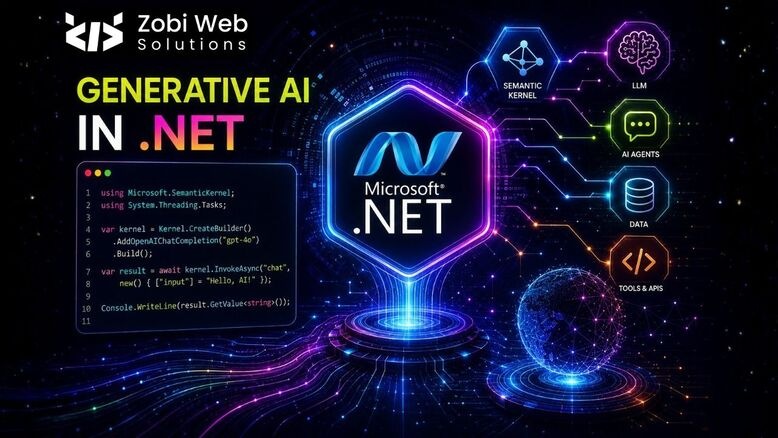
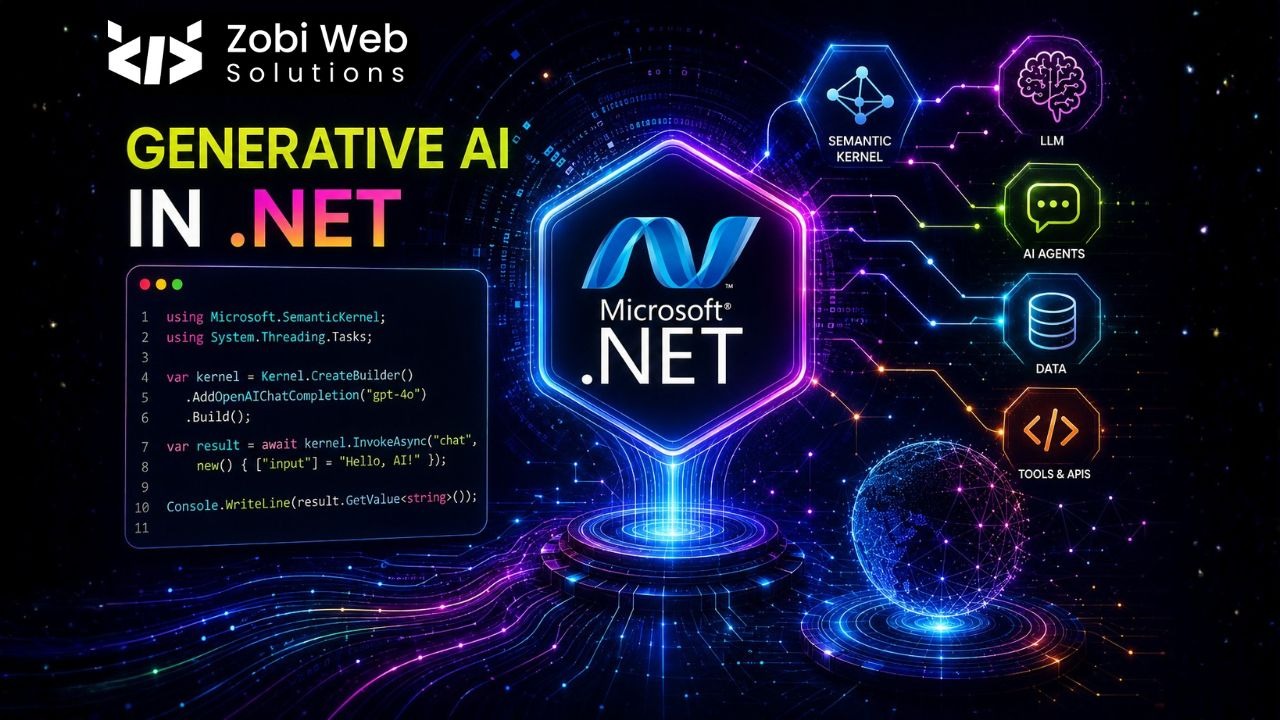
Generative AI has rapidly evolved from an emerging technology into a practical solution for modern software development. Businesses are increasingly adopting AI-powered applications to automate workflows, improve customer experiences, generate content, and unlock insights from enterprise data. For .NET developers, this shift presents an opportunity to build applications that are not only functional but also intelligent, context-aware, and capable of assisting users in real time.
Microsoft has embraced this transformation by introducing a comprehensive AI ecosystem for .NET developers. Technologies such as Semantic Kernel, Azure OpenAI Service, and Retrieval-Augmented Generation (RAG) make it easier to integrate Large Language Models (LLMs) into enterprise applications while maintaining security, scalability, and business logic.
At Zobi Web Solutions, we help businesses leverage these technologies to build AI-powered .NET applications that solve real-world challenges. Whether it’s developing intelligent chatbots, automating document processing, or creating enterprise knowledge assistants, our focus is on delivering secure and scalable AI solutions that create measurable business value.
What Is Generative AI?
Generative AI is a branch of artificial intelligence that creates new content based on user input instead of simply analyzing existing information. Unlike traditional software that follows predefined rules, generative AI understands context, recognizes language patterns, and generates meaningful responses.
Today, Generative AI is used to create:
- Business reports and documentation
- Software code and development assistance
- Customer support responses
- Email drafts and content
- Product descriptions
- Document summaries
These capabilities are powered by Large Language Models (LLMs), which are trained on billions of text tokens to understand language, context, and relationships between words. Rather than retrieving predefined answers, these models predict the most relevant response based on the information they receive.
For businesses, this means applications can become more interactive, adaptive, and capable of handling tasks that previously required significant human effort.
How Large Language Models Understand Language
Although AI-generated responses may appear human-like, large language models process information mathematically.
Every sentence is divided into smaller units called tokens. These tokens are then converted into embeddings, numerical representations that capture the meaning and relationships between words
This allows AI models to understand context rather than simply matching keywords.
For example, the word “bank” could refer to a financial institution or the side of a river. By analyzing surrounding words, the model determines the intended meaning before generating a response.
This semantic understanding enables applications to perform tasks such as:
- Intelligent document search
- Text summarisation
- Language translation
- Content generation
- Natural language conversations
- Code generation
Instead of relying solely on rules, AI applications interpret user intent and generate responses based on context.
Why AI Integration in .NET Matters
Traditional enterprise applications are designed around predefined workflows and business rules. While this approach remains essential, modern businesses increasingly expect applications to understand natural language, retrieve information intelligently, and assist users with complex tasks.
This is where AI Integration in .NET becomes valuable.
By combining AI capabilities with the reliability of the .NET framework, developers can build applications that enhance productivity while maintaining full control over business processes.
Common enterprise use cases include:
- AI-powered customer support assistants
- Intelligent document processing
- Internal knowledge management systems
- Contract and invoice summarisation
- Code generation for development teams
- Workflow automation through natural language commands
Rather than replacing traditional software development, Generative AI enhances existing applications by making them smarter, faster, and more user-friendly.
Semantic Kernel: Microsoft’s AI Framework for .NET
One of Microsoft’s most significant contributions to AI development is Semantic Kernel.
Semantic Kernel is an open-source SDK that enables developers to integrate AI into .NET applications using structured and reusable workflows. Instead of embedding prompts throughout the codebase, developers can organize prompts, AI services, memory, and business logic into maintainable components.
With Semantic Kernel, developers can:
- Create reusable prompt templates
- Maintain conversational context
- Connect AI with native C# methods
- Chain multiple AI operations into workflows
- Build intelligent assistants for enterprise applications
This orchestration approach makes AI applications easier to scale, maintain, and test compared to simple API-based implementations.
Instead of treating AI as an isolated feature, Semantic Kernel allows developers to make it an integral part of their application’s architecture.
Retrieval-Augmented Generation (RAG): Making AI More Accurate
One of the biggest challenges with Large Language Models is that they can occasionally generate inaccurate or outdated information. In enterprise applications, where decisions rely on trusted data, this can become a significant concern.
Retrieval-Augmented Generation (RAG) solves this problem by allowing the application to retrieve relevant information from trusted data sources before the AI generates a response. Instead of relying only on the model’s training data, the AI is provided with real-time business context.
For example, an employee asking about a company’s leave policy can receive an answer generated directly from the latest HR documentation rather than a generic response.
RAG can retrieve information from:
- Internal knowledge bases
- Company documentation
- Product manuals
- CRM systems
- Enterprise databases
- SharePoint or cloud storage
By grounding responses in trusted business data, RAG improves accuracy, reduces AI hallucinations, and makes Generative AI suitable for enterprise applications.
Traditional .NET Applications vs AI-Powered .NET Applications
Generative AI doesn’t replace traditional application development; it enhances it. By combining deterministic business logic with AI-driven reasoning, organisations can create applications that deliver more intelligent and personalised experiences.
| Traditional .NET Applications | AI-Powered .NET Applications |
| Rule-based workflows | Context-aware decision support |
| Keyword-based search | Semantic search using embeddings |
| Static responses | AI-generated responses |
| Manual document analysis | Intelligent document summarisation |
| Fixed user interactions | Natural language conversations |
This combination allows businesses to automate repetitive tasks while still maintaining complete control over business rules and application logic.
Best Practices for AI Integration in .NET
Successfully integrating Generative AI into enterprise applications requires thoughtful planning. Following proven practices helps ensure your AI solutions remain secure, reliable, and scalable.
Use structured prompts
Store prompts as reusable templates instead of embedding them directly into application code. This makes updates and testing much easier.
Ground responses with RAG
Always provide the AI with trusted business information before generating responses to improve accuracy and reduce hallucinations.
Validate AI-generated outputs
AI should support business decisions, not replace them. Validate outputs before executing actions such as database updates, approvals, or customer communications.
Protect sensitive information
Avoid including confidential business data or personally identifiable information in prompts unless proper security and compliance measures are in place.
Monitor and improve continuously
Review AI interactions regularly, refine prompts, and measure performance to ensure your application continues delivering accurate and relevant responses.
Why .NET Is an Excellent Platform for Generative AI
The Microsoft ecosystem provides everything developers need to build secure, scalable, and enterprise-ready AI applications.
With features such as Dependency Injection, Clean Architecture, ASP.NET Core, cloud-native development, and seamless integration with Azure AI services, .NET simplifies embedding intelligence into modern applications.
Combined with technologies like Semantic Kernel and Retrieval-Augmented Generation, developers can create AI-powered solutions that are maintainable, secure, and aligned with enterprise requirements.
Whether you’re building a customer support assistant, an internal knowledge portal, or an AI-powered business application, .NET offers the flexibility and performance required for production-ready deployments.
Real-World Applications of Generative AI in .NET
Organizations across industries are already using Generative AI to improve operations and deliver better user experiences.
Some common use cases include:
- AI Customer Support: Deliver instant, context-aware responses while reducing support workloads.
- Document Automation: Summarise contracts, invoices, reports, and technical documents within seconds.
- Enterprise Knowledge Assistants: Help employees quickly retrieve information from internal documentation and knowledge bases.
- Software Development Assistance: Generate code snippets, documentation, and debugging suggestions to improve developer productivity.
- Workflow Automation: Enable users to perform complex business tasks through simple natural language commands.
These applications demonstrate how AI can extend existing .NET systems without replacing proven business processes.
Ready to Build AI-Powered .NET Applications?
Generative AI is no longer an experimental technology; it’s becoming a core part of modern software development. By combining Large Language Models (LLMs), Semantic Kernel, Retrieval-Augmented Generation (RAG), and AI integration within the .NET ecosystem, businesses can build smarter applications that automate processes, enhance user experiences, and deliver measurable business value.
From intelligent knowledge assistants and document automation to AI-powered customer support and workflow optimization, the opportunities for innovation continue to grow. Organizations that embrace these technologies today will be better positioned to improve operational efficiency, unlock valuable insights, and gain a competitive advantage in an increasingly AI-driven world.
Whether you’re modernizing an existing .NET application or building an AI-first solution from the ground up, Zobi Web Solutions helps businesses design, develop, and integrate secure, scalable, and enterprise-ready AI solutions. Our team combines deep .NET expertise with the latest Microsoft AI technologies to deliver intelligent applications that solve real business challenges and support long-term digital transformation.